
Why the likes of Bronwyn Bishop and Nick Kyrgios self-implode
By Dennis Mazalin
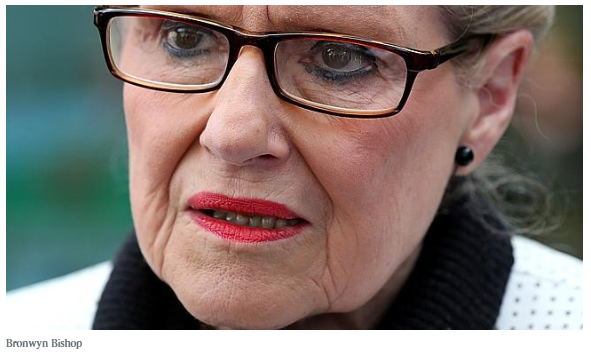
It was as if Bronwyn Bishop herself had crashed the helicopter during the infamous 80km flight from Melbourne to Geelong that sealed her political fate.
The federal politician will forever be remembered for the travel entitlements debacle that cost her the speakership of the House of Representatives.
Her stubbornness during the scandal further damaged her reputation, making it the biggest case of political self-sabotage this year.
We cast a curious eye over public figures self-imploding, with a strange mix of disdain, sympathy and schadenfreude. It’s fascinating to observe it. But beware, there’s a self-saboteur within us all.
Gifted tennis bad boy Nick Kyrgios recently self-sabotaged his way through several PR disasters, including battles with Wimbledon officials and distasteful sledging of Stan Wawrinka. It culminated in widespread condemnation and him forfeiting his place on the Davis Cup team.
We watch from afar as those in the public eye get in the way of themselves. But within ourselves, a self-annihilating entity lurks in the crevices of our minds — waiting to hinder, plunder, or hurt (ourselves).
In most of us it is a mild beast, often little more than procrastination, or forgetting to take our passport to the airport. But extreme events can produce damaging actions that can have dire consequences. And you don’t need to be a figure in the public eye to suffer the full force of its effects.
Self-sabotage is a combination of self-destructive behaviours, says Edward Selby, an expert in self-injurious behaviour. He defines these as thoughts and emotions that can interfere with long-term goals, creating new problems and unsettling relationships.
We spend an unprecedented amount of money, time and effort on achieving success, looking better, feeling healthier and getting on with people. Yet all of us can self-sabotage. It’s quite a paradox.
Psychiatrist George Wahr describes the condition as internal conflict between opposing aspects of our mind or personality. This seems to be part of Kyrgios’s problem. By his own admission he is unsure about his tennis career. Leading sports psychologist Jeff Bond says he appears confused. This tension between his tennis career and other roles seems to be fuelling his self-saboteur.
There’s an easy psychological litmus test we can take to assess self-sabotage. Assess if a negative outcome reflects behaviour that doesn’t fit with our personality or our goals.
It made no sense for Hawthorn captain Luke Hodge to risk his place in his club’s finals campaign by drink-driving. “I was an idiot,” Hodge explained. I figure he was referring to the self-saboteur within. Luckily, he was able to play on.
Why does a student get drunk the night before an exam? Why do you ignore that niggling health issue rather than visit the doctor? Why did your friend risk their nest egg on that high-risk investment?
Such personal unhinging can happen below the level of immediate awareness, the veiled product of our unconscious minds. Brain scans do not reveal its identity, it moves with stealth, an internal mole working towards its sole purpose — undermining us.
Sometimes self-sabotage is a conscious act. I am lactose intolerant, but occasionally I devour creamy French cheeses with the full insight that it will cause a night of stomach cramping and flatulence. I guess my desire for some comfort food outweighs the predictable unsettling aftermath.
There are Freudian theories about why are we sometimes our own worst enemies; ideas about guilt, or a death drive. It may also be due to poor self-esteem and unhealthy coping mechanisms, or earlier learnt maladaptive behaviours and mindsets gleaned from our parents.
But we don’t self-sabotage all the time, and rarely is it life-threatening. In fact, anything psychological sits on a continuum, from mild to severe — mostly at the lighter end of that scale, the dysfunction surfacing occasionally, usually in minor ways.
When severe, it’s extremely damaging and may suggest a personality disorder. A woman I once knew had a series of abusive partners — two violently placing her in hospital. Friends could see it, yet she perpetually found excuses for the bad behaviour. Denial is a factor that keeps driving it.
Self-sabotage is not a stand-alone diagnostic condition, but does figure in many psychological problems. It is not clear if it is on the rise, but there’s growing awareness. The American Psychiatric Association has for some years flirted with formal inclusion of it in its Diagnostic and Statistical Manual of Mental Disorders.
The DSM contains the standard classification of mental disorders. If a disorder makes it into the DSM, that means that it is well understood and is distinct from other disorders. Self-sabotage was explored in an earlier version of the DSM, but was eventually abandoned after it was judged too similar to other disorders.
The recent DSM-5 contains a proposal to include a proposed disorder called non-suicidal self injury, but requests further study. NSSI involves intentionally causing injury to one’s own body without suicidal intent. It is similar to self-sabotage, yet the physical manifestations are potentially more severe.
Thus self-sabotage struggles to find a clinical identity. This lack of formal pathology should not stop us from trying to understand it. The internal-saboteur’s more subtle hand can make us procrastinate, not exercise, overeat, lose that important file, or even drive our pregnant wife to the wrong hospital. Some of these may be basic human error, despite Freud’s belief that there are no mistakes.
While some people will remain in denial, I think it is better to know that self-sabotage is an actual thing. This helps keep it in check.
Therapy, self-help books and other forms of self-improvement can be useful. So if you are prone to self-sabotage, experiment with healthier behaviours. They help create new habits. Try to replace persistent self-sabotaging thinking with a clearer mind. Meditation and mindfulness can assist.
The paradoxical nature of the self-saboteur reflects a broader contradiction within humanity. We build things only to destroy them later, and then we build some more.
This appears to be the cycle of life. But there’s no need for actual personal destruction, whether it be the end of an actor’s career (as in the case of Mel Gibson), or the onset of illness through neglect.
Maybe it’s enough to just brush up against it every so often and sense the self-saboteur’s presence. In this way the condition might actually help us thrive, reminding us to respect ourselves, and the wonderful opportunity that being alive presents.
Dennis Mazalin is a Melbourne clinical psychologist.